Independent guide · not affiliated with, or endorsed by, Antalya Airport (AYT)
Baggage and Liquid Rules at Antalya Airport (AYT)
Two different rulebooks apply to your bags at Antalya Airport, and mixing them up is what goes wrong at the checkpoint. Your airline decides how many bags you may bring and how much they may weigh. Aviation security decides what is allowed through the screening point at all — including the 100 ml liquid rule, which the airport applies regardless of which airline you fly. This page covers both: the security rules as the airport itself states them, and the cabin and checked allowances of the carriers that actually operate from AYT.
- Personal item
- 1× max 40×30×15 cm
- Cabin bag
- 1× max 55×40×23 cm, up to 8 kg
- Checked bag
- Not included on domestic/short-haul
Baggage rules and fees change often and can vary by route or booking channel — always check your exact fare's allowance during booking.
Last verified: July 2026
Who sets which rule
On allowances, the airport's own answer is short: for baggage allowances, contact your airline. Size, weight, how many pieces and what an extra bag costs are set by the carrier and by the fare you bought, not by the airport — which is why the checker above is organised by airline and fare rather than by terminal. What the airport and aviation security do control is what may pass the screening point: liquids, sharp objects and dangerous goods. Those rules are identical for a Turkish Airlines passenger and an easyJet passenger standing in the same queue.
The liquid rule at Antalya Airport
Liquids in hand luggage must be in individual containers of no more than 100 millilitres each. Those containers go into one transparent, re-sealable plastic bag with a capacity of no more than 1 litre, sized 20 cm × 20 cm. Each passenger may carry only one such bag. At the checkpoint the bag has to be presented for examination and screened separately from your cabin bag, so keep it somewhere you can reach without unpacking. The limit is the container size, not how much is left inside it: a half-empty 200 ml bottle is still a 200 ml container and will be taken off you.
What counts as a liquid
The airport's own list is wider than most passengers expect: water and other drinks, soups and syrups; creams, lotions and oils; perfumes; sprays; gels, including hair and shower gels; the contents of pressurised containers, including foams and deodorants; pastes, including toothpaste; liquid-solid mixtures; mascara; and any other item of similar consistency. In practice that pulls in most of a washbag — toothpaste, deodorant, sunscreen and mascara are all liquids for screening purposes, and all four have to fit inside the same one-litre bag.
Medicines and baby food
You may still carry medicines and special dietary requirements, including baby foods, in your hand luggage for use during the trip, and these are not held to the 100 ml container limit. Two things make this go smoothly: bring them separately from the one-litre bag, and be ready to prove what they are. You may be asked to provide proof and to demonstrate the contents, so keep prescriptions, pharmacy labels or a doctor's note with the items rather than in your checked bag.
Duty-free liquids and sealed bags
Tax-free liquids bought at the duty-free shops beyond passport control, or on board your aircraft, are permitted and do not have to fit in your one-litre bag. They come sealed in a tamper-evident bag with the receipt visible inside, and the seal is the whole point: if you open it before the end of your journey, the contents can be confiscated at the next screening point. This matters most on connections — if you are transferring through an EU airport, the bag has to stay sealed at every transfer screening point along the way, so buy the bottle knowing you cannot open it until you land.
What security will take out of your hand luggage
Beyond liquids, the airport lists items that must not be packed in hand luggage and may be confiscated if found: scissors, except where both blades are round-ended or shorter than three centimetres; razor blades, though razors with the blade set into a plastic moulding are allowed and razors that can be opened to remove the blade are not; knives, including pen knives, with blades of any length; corkscrews; darts; bats; and toy or replica guns, whether metal or plastic. Hypodermic needles are prohibited unless required for medical reasons, for which proof will be required. The airport is explicit that it cannot list every possible prohibited item, so anything blade-like or weapon-shaped belongs in your checked bag.
What cannot go in any bag
A separate list applies to dangerous goods, and these are barred from checked luggage as well as the cabin: flammable liquids or solids; organic peroxides; tear gas devices and gas cylinders of any kind; infectious substances such as live virus materials; wet-cell car batteries; instruments containing mercury; instruments containing magnets; fireworks; non-safety matches; fire lighters, lighter fuel, paints and thinners; poisons, arsenic, cyanide and weed killer; and radioactive materials, acids, corrosives, alkalis, caustic soda and bleaching powders. Checking a bag does not make any of these travel — they simply cannot fly.
Bulky and special items
Skis, baby carriages, parasols, wheelchairs, surfboards, sail boards, fishing rods, diving equipment, backpacks, golf bags, bicycles and musical instruments may all be subject to special conditions, and the airport's instruction is to ask your airline before you travel rather than at the desk. Conditions usually cover packing, whether the item counts against your normal allowance, and what it costs — all of which are set by the carrier. Sort it out at booking: an oversized item declared in advance is routine, the same item turning up unannounced at check-in is not.
At the security checkpoint
All metal objects go into the plastic trays provided — mobile phones, computers, cameras, keys and coins included — and coats and belts come off. Children have to be taken out of strollers, and the stroller folded for x-ray screening. Passengers pass through one at a time, and everything must be on the x-ray conveyor belt before you walk through the metal detector. Cooperation is not optional: refusing means you will not be permitted through the screening point or allowed to board.
Trolleys, wrapping and luggage lockers
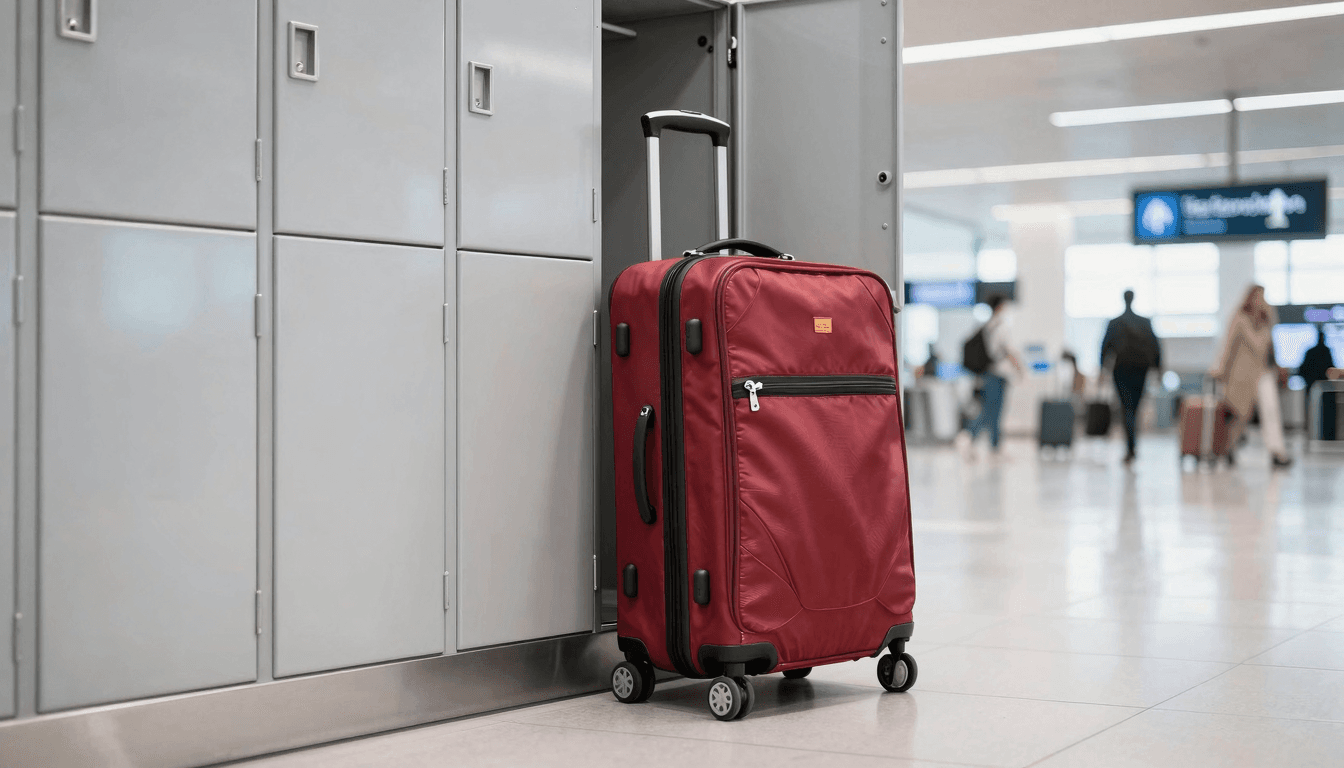
Baggage trolleys are available inside and outside the terminals — in the departure halls, the arrival halls and the parking areas. Baggage wrapping runs 24 hours a day for a fee in the Terminal 1 and Terminal 2 departure halls, operated by an external provider. If you want to put bags down rather than carry them, luggage lockers are in the arrival hall of the Domestic Terminal, and they serve passengers departing from Terminal 1 or from the Domestic Terminal — worth knowing before you plan a day in the city around them, because Terminal 2 does not have its own.
If a bag is damaged, delayed or lost
Which desk you need depends on what went missing. A checked bag that did not arrive is the ground handler's responsibility, not the airport's, and Antalya has several — Havas, Çelebi, TGS and FUGO each run their own lost-and-found office, and which one is yours depends on who handles your airline. Report it before you leave the baggage reclaim hall and file a report there; a claim is far harder to open once you have gone through customs. Something left behind in the terminal itself is different: that goes to the Fraport TAV Antalya Airport lost-and-found office, which handles items found in the building rather than bags lost in transit.
Frequently asked questions
No. Every container of liquid in hand luggage has to be 100 ml or smaller, and the rule goes by the size printed on the container rather than by how much is left inside it. A 150 ml tube that is half used is still a 150 ml container, so it either goes in your checked bag or stays behind at the checkpoint.
One transparent, re-sealable plastic bag with a capacity of no more than 1 litre, sized 20 cm × 20 cm. Each passenger may carry only one, and it has to be presented at the checkpoint and screened separately from your cabin bag — so it goes in a pocket you can reach, not at the bottom of your case.
No. Tax-free liquids bought beyond passport control or on board the aircraft are permitted on top of your one-litre bag. They are handed over sealed in a tamper-evident bag with the receipt inside, and that seal has to stay intact — open it early and the contents can be confiscated at the next screening point. If you are connecting through an EU airport, keep it sealed at every transfer screening point.
Yes. Medicines and special dietary requirements, including baby foods, may be carried in hand luggage for use during the trip and are not held to the 100 ml limit. Keep them separate from your one-litre bag and carry the paperwork with them — you may be asked to provide proof and to demonstrate the contents.
No. Weight, size and the number of pieces are set by your airline and by the fare you booked, and the airport's own guidance is to contact the airline about allowances. Use the checker on this page for the carriers that fly from AYT — Turkish Airlines, Pegasus, SunExpress and easyJet — and confirm against your booking, because allowances differ between fare tiers of the same airline.
Partly. Scissors are allowed only where both blades are round-ended or shorter than three centimetres. Razors with the blade set into a plastic moulding are fine; razors that can be opened so the blade comes out are not, and loose razor blades are prohibited. Knives of any blade length, including pen knives, are not allowed in the cabin at all.
Yes, but in one place only: luggage lockers are in the arrival hall of the Domestic Terminal, and they serve passengers departing from Terminal 1 or the Domestic Terminal. There is no equivalent inside Terminal 2, which is worth checking against your own terminal before you count on leaving bags there. Baggage wrapping, by contrast, is available 24 hours a day for a fee in both the Terminal 1 and Terminal 2 departure halls.
The ground handler for your airline, not the airport. Havas, Çelebi, TGS and FUGO each run a lost-and-found office at Antalya, and which one is yours depends on who handles your carrier. Report it before you leave the baggage reclaim hall. An item you left somewhere in the terminal is a different matter and goes to the Fraport TAV Antalya Airport lost-and-found office.
Related guides
Left Luggage and Baggage Storage Facilities
If you have a long layover or want to explore the city unburdened, baggage storage is available. Location If you are departing from Terminal…
How Early Should I Arrive at Antalya Airport?
To ensure a stress-free departure, it is crucial to arrive at the airport with plenty of time to spare. International Flights We recommend a…
Fast Track Security
Skip the long lines during peak season with Fast Track services. What is Fast Track? Fast Track allows you to use a dedicated priority lane…
Duty-Free Shopping Guide
Antalya Airport offers extensive Duty-Free shopping options for international travelers. Locations The main Duty-Free stores are located in…
Currency Exchange and ATMs
Whether you need Turkish Lira (TRY) or foreign currency, financial services are widely available. Currency Exchange (Döviz) Exchange offices…
Airport Lounges at Antalya Airport
Escape the crowds and relax in one of Antalya Airport's premium lounges before your flight. CIP Lounges There are CIP Lounges in both Termin…